Why floor space matters
Hamsters are active, ground-dwelling animals. In the wild, they travel, forage, dig, build burrows, and explore large areas. A small starter cage cannot provide enough room for those natural behaviors, even if it has tubes, platforms, or extra levels attached.
Choose an enclosure with generous unbroken floor space so your hamster has room to explore, forage, burrow, and use enrichment properly. We recommend a minimum of 800 square inches of continuous floor space for Syrian hamsters and 600–800 square inches for dwarf species, though larger enclosures are always preferred.
The easiest rule
Look for one large, flat, continuous base. Levels, tubes, shelves, and lookout platforms should not be counted as the main floor space.
Proper vs. improper enclosures
Many cages are marketed as “hamster cages” even when they are too small, too shallow, or too tall. The best enclosure gives your hamster a large base, deep bedding, safe enrichment, and enough room for a properly sized wheel.

Large unbroken floor space
A good enclosure has one large base area where your hamster can run, forage, burrow, and explore without being cramped.
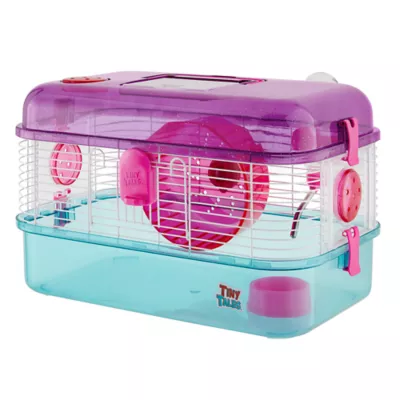
Small starter cage
Many small store cages do not have enough room for deep bedding, a proper wheel, hides, clutter, and natural movement.

Tall cage with levels
Hamsters are not built like rats or mice. Tall levels can create fall risks and do not replace proper floor space.
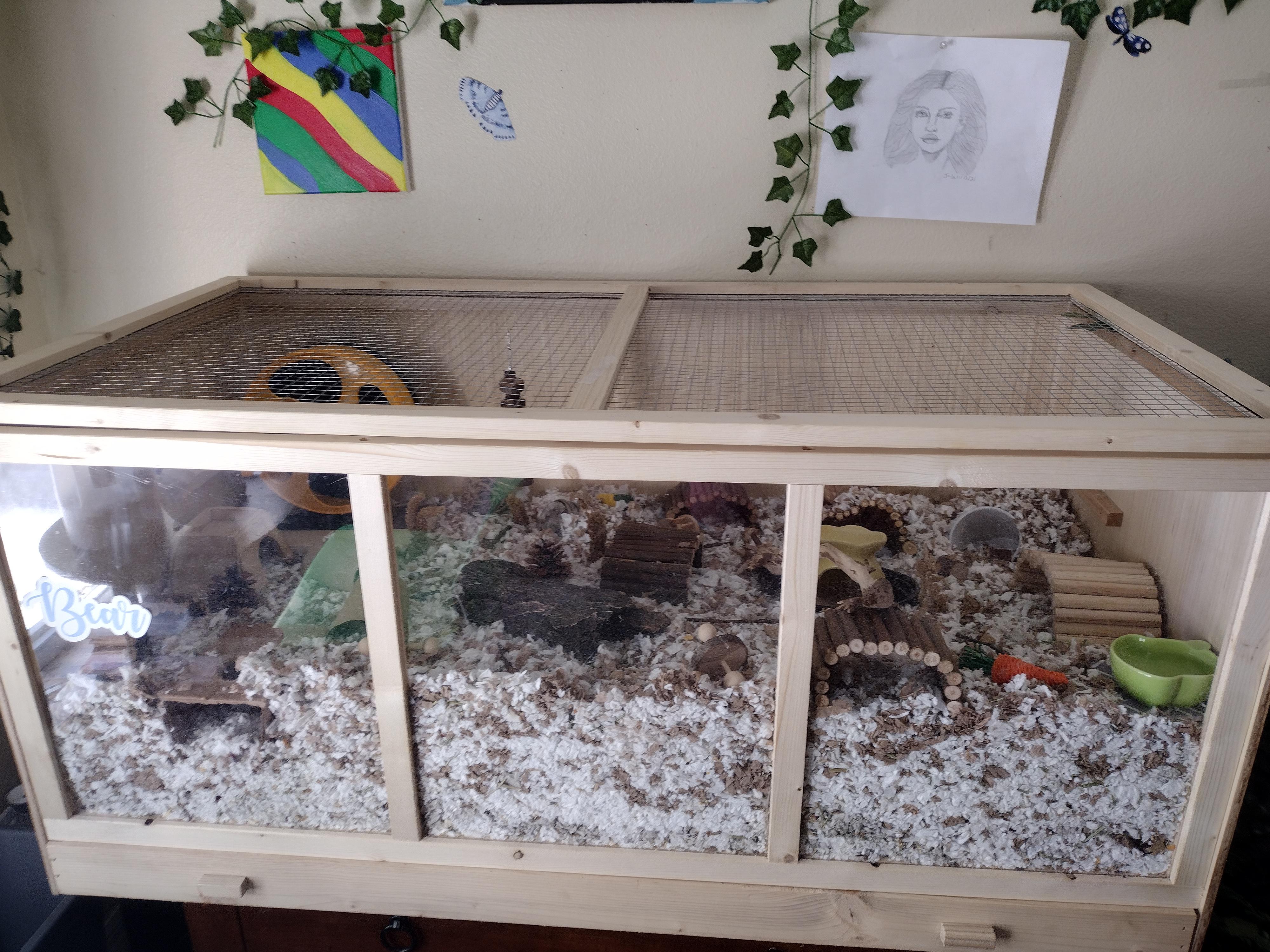
Deep bedding area
A proper enclosure should have enough height and base space for deep bedding so your hamster can build burrows.
How to measure floor space
Floor space is measured by multiplying the inside length by the inside width of the main base. Only count the continuous bottom area that your hamster can actually use. Shelves, tubes, balconies, and small connected cages do not fix a base that is too small.
inside length × inside width = square inches
Example: a 40 inch long enclosure that is 20 inches wide has 800 square inches of floor space.
| Enclosure size | Floor space | Care quality | Notes |
|---|---|---|---|
| 24 in × 12 in | 288 sq in | Too small | Common in starter cages, but not enough room for proper enrichment. |
| 30 in × 12 in | 360 sq in | Too small | Still cramped and usually cannot hold enough bedding or a proper wheel. |
| 36 in × 18 in | 648 sq in | Better for some dwarfs | May work for some dwarf hamsters, but bigger is still recommended. |
| 40 in × 20 in | 800 sq in | Recommended baseline | A strong minimum target for most hamsters, especially when well set up. |
| 48 in × 24 in | 1,152 sq in | Excellent | Gives much more room for bedding, clutter, digging areas, and enrichment. |
Recommended minimums
There is no single perfect number that fits every hamster, because personality, species, body size, and enrichment all matter. However, small cages are one of the biggest problems in hamster care, so using a generous minimum helps prevent many common welfare issues.
| Hamster type | Minimum target | Better target | Why bigger helps |
|---|---|---|---|
| Dwarf hamster | 600–800 sq in | 800+ sq in | More room for sand, sprays, hides, tunnels, and separate activity zones. |
| Roborovski hamster | 600–800 sq in | 800+ sq in | Robos are tiny but extremely active and often use a surprising amount of space. |
| Chinese hamster | 700–800 sq in | 900+ sq in | Their longer body and active nature make extra floor space useful. |
| Syrian hamster | 800 sq in | 1,000+ sq in | Syrians are larger and need more room for a large wheel, hides, and deep bedding. |
Why levels and tubes do not count
Levels can look like extra space, but they do not provide the same value as a large base. Hamsters need horizontal space to move naturally. A narrow shelf does not give them the same ability to run, dig, forage, or build tunnels.
Tubes can also be a problem. They may be difficult to clean, poorly ventilated, too narrow for larger hamsters, and easy for food or bedding to get stuck inside. They can be used carefully as enrichment in some setups, but they should not be the main living area or the reason a small cage is considered acceptable.
- Do not count shelves as floor space. Shelves are bonus areas only. The main base still needs to be large enough by itself.
- Do not rely on tall climbing space. Hamsters can climb, but they are not naturally skilled climbers. Falls can be dangerous.
- Do not connect multiple tiny cages as a substitute. Several cramped cages connected by tubes are still not the same as one large continuous enclosure.
Depth matters too
Floor space is important, but it is not the only measurement that matters. Hamsters also need enough bedding depth to dig and build burrows. A cage with a large base but only a thin layer of bedding is still missing one of the most important parts of hamster care.
A good enclosure should be tall enough to hold deep bedding while still fitting a safe wheel, hides, cork logs, sprays, tunnels, and other enrichment. For most setups, aim for at least 8 inches of bedding, with deeper areas being even better.
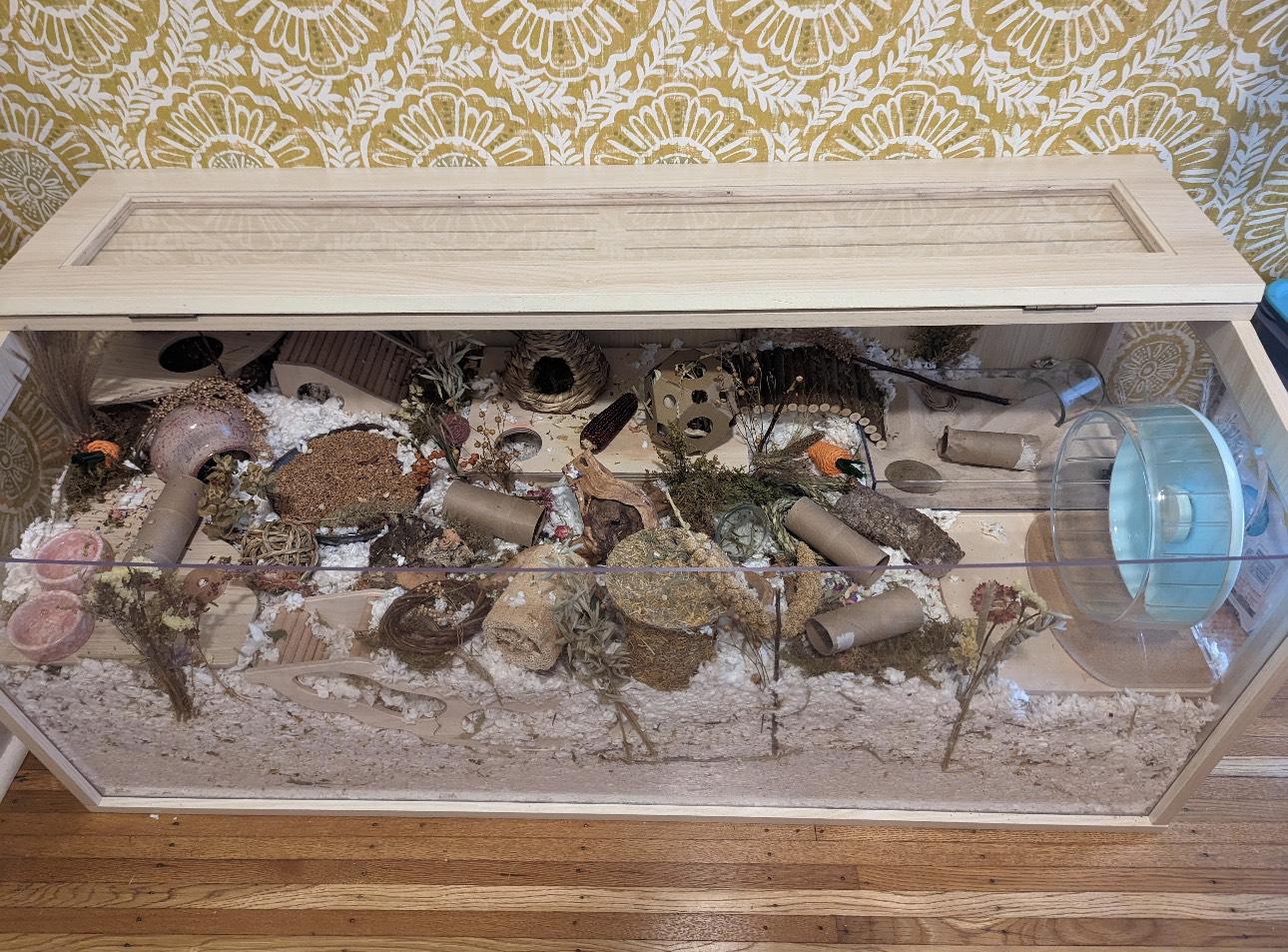
A large enclosure works best when it is filled with safe clutter, hides, bedding, sprays, tunnels, and natural enrichment.
What a good enclosure should fit
A properly sized enclosure should comfortably fit all of the essentials without feeling empty or cramped. Hamsters feel safer when their enclosure has cover, clutter, and places to hide. A large open box with no enrichment is better than a tiny cage, but it still should be properly set up.
- A proper wheel The enclosure should fit a species-appropriate upright wheel without forcing you to remove bedding or important enrichment.
- Deep bedding Your hamster should have enough bedding to dig, tunnel, and create burrows.
- Multiple hides Include several hides so your hamster can move around while feeling covered and secure.
- A sand bath Sand helps with grooming and gives your hamster another natural activity area.
- Foraging enrichment Sprays, scattered food, herbs, cork logs, tunnels, and dig boxes encourage natural behavior.
- Safe open paths The enclosure should have enough room for movement while still being cluttered enough to feel safe.
Good enclosure types
There are several ways to create a proper hamster enclosure. The best option depends on your budget, space, and how comfortable you are with DIY work.
- Glass tanks Tanks can be great because they hold deep bedding well, reduce bedding mess, and allow clear viewing. They need a secure mesh lid for ventilation.
- Large bin cages A properly sized storage bin can work well if it is large enough and has safe ventilation added with mesh.
- DIY wooden enclosures DIY cages can provide excellent space, but wood should be protected from urine and chewing where needed.
- Large front-opening enclosures These can make interaction and cleaning easier, but they still need enough bedding depth and floor space.
Enclosures to avoid
Some cages are common in pet stores because they are cheap, colorful, and easy to display. Unfortunately, many of them are not suitable as permanent hamster homes.
- Tiny colorful starter cages These usually have very little floor space, shallow bases, tiny wheels, and not enough room for proper enrichment.
- Tall cages with narrow levels Height does not replace floor space, and falls can be risky.
- Wire floors or wire shelves Hamsters should have solid surfaces under their feet. Wire flooring can be uncomfortable and unsafe.
- Tube-heavy cages Tubes can be hard to clean, poorly ventilated, and too small for larger hamsters.
- Enclosures that cannot hold deep bedding A shallow base prevents proper burrowing and usually creates constant bedding mess.
Signs the enclosure may be too small
Some hamsters are more active or more demanding than others. Even if an enclosure technically meets a minimum, your hamster may still show signs that they need more space, more bedding, or more enrichment.
- Bar biting Repeated chewing on bars can be a stress behavior, especially in small or boring cages.
- Repeated pacing Running the same path over and over can mean the hamster is frustrated or under-stimulated.
- Trying to escape constantly Climbing corners, pushing lids, or obsessively searching for exits may mean the enclosure is not meeting their needs.
- Ignoring enrichment Some hamsters shut down in poor setups, so lack of activity does not always mean the cage is good.
Final recommendation
A good hamster enclosure should be large, deep, secure, and well-cluttered. For dwarf hamsters, aim for at least 600–800 square inches, with 800+ being better. For Syrian hamsters, aim for at least 800 square inches, with 1,000+ being even better.
Best choice
Choose one large enclosure with unbroken floor space, deep bedding, a proper wheel, multiple hides, a sand bath, and plenty of safe clutter. Bigger is almost always better when the space is set up correctly.